Tomato late blight is one of the most destructive diseases in tomato production. Its pathogen, Phytophthora infestans, belongs to the Oomycetes and primarily infects tomato leaves, petioles, stems, and fruits. In cool, humid environments with frequent rainfall, the pathogen can rapidly multiply and spread; in severe cases, it can cause widespread leaf necrosis, stem infection, and fruit rot within a short period of time.
Unlike some slower-developing foliar diseases, Tomato Late Blight is characterized by rapidly expanding lesions, strong transmissibility, and the potential to rapidly form new infection foci under favorable conditions. Therefore, control measures cannot rely solely on curative applications after lesions are detected. Growers need to combine weather monitoring, disease identification, field sanitation, and preventive fungicide protection to minimize the risk of infection as early as possible.
For pesticide importers and distributors, selecting fungicides for tomato late blight also requires attention to the active ingredient’s mode of action, FRAC Group, local pathogen susceptibility, and product registration scope. Different fungicides are not simply interchangeable; only by understanding their specific characteristics and resistance risks can a fungicide portfolio suitable for local tomato production be established.
What Causes Tomato Late Blight?
Tomato late blight is caused by Phytophthora infestans, an oomycete pathogen commonly known as a water mold.
Although it is often classified under the management of fungal diseases in agricultural production, from a biological taxonomic perspective, oomycetes are distinct from true fungi. This distinction directly impacts the selection of fungicides, as not all products designed to combat common fungal diseases can effectively control P. infestans.
Pathogen Characteristics of Phytoph thora infestans
Phytophthora infestans can infect tomatoes, potatoes, and certain other Solanaceae host plants.
It is primarily transmitted via sporangia. Under favorable conditions, sporangia can reach healthy plants through airborne dispersal or rain splash.
At suitable temperatures and in the presence of a water film, sporangia can germinate, releasing zoospores (zoospores), or germinate directly to form germ tubes, which subsequently invade plant tissue.
Its primary transmission processes include:
| Development Stage | Biological Process |
|---|---|
| Inoculum Survival | The pathogen survives in infected host tissue, potato tubers, or other suitable sources |
| Sporangia Formation | Sporangia form in infected tissue under suitable conditions |
| Spore Dispersal | Spores are dispersed via air and water droplets |
| Germination | Sporangia germinate, releasing zoospores under certain conditions |
| Plant Infection | The pathogen enters plant tissue through a suitable entry point |
| Secondary Sporulation | Infected tissue forms new sporangia, leading to subsequent infections |
The primary overwintering sources of the pathogen may vary by region. Growers should pay particular attention to infected potato tubers, volunteer potato and tomato plants, and other local host plants; it cannot be simply assumed that soil is the primary overwintering source of the pathogen in all regions.
Difference Between Tomato Late Blight and Early Blight
Tomato late blight and tomato early blight are two distinct diseases.
Although both cause leaf browning and necrosis, there are clear differences in the pathogens, infection conditions, and choice of fungicides.
| Comparison | Late Blight | Early Blight |
|---|---|---|
| Main Pathogen | Phytophthora infestans | Alternaria solani and others |
| Pathogen Type | Oomycete | True Fungus |
| Typical Leaf Symptoms | Water-soaked, irregular purplish-brown lesions | Concentric, ring-shaped brown lesions |
| Main Environmental Conditions | Cool to mild, humid | Warm, with moist leaves |
| Fruit Symptoms | Solid brown lesions | Concentric ring-shaped or sunken lesions |
| Fungicide Selection | Oomycete-active Fungicides | Fungicides effective against Alternaria |
If growers confuse the two diseases, they may select a fungicide that is not suitable for the target pathogen.
Therefore, before selecting a product, the type of disease should be confirmed rather than applying fungicide immediately based solely on the presence of brown spots on the leaves.
What Are the Symptoms of Tomato Late Blight?
Tomato late blight can infect tomato leaves, petioles, stems, and fruit. Early symptoms may not be obvious, but under favorable conditions, lesions can spread rapidly.
Leaf Symptoms: Water-soaked Lesions and Brown Blotches
Leaves are typically the most visible site of damage caused by late blight.
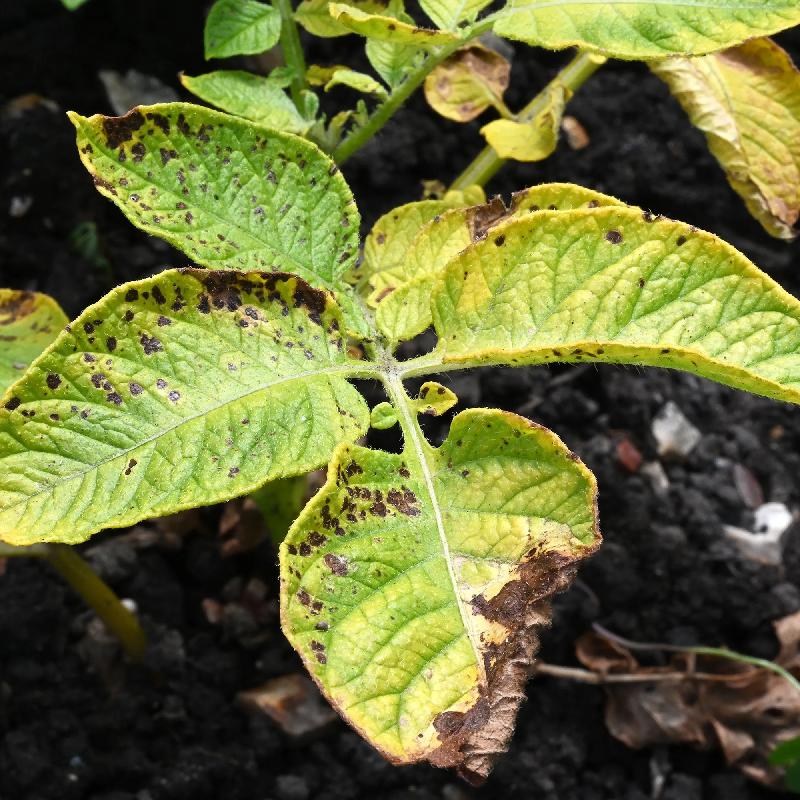
Initial lesions may appear as irregular, light green or gray-green water-soaked spots.
As the infection progresses, the lesions gradually expand, turning purple-brown, dark brown, or nearly black, forming distinct areas of necrosis.
Major symptoms include:
- Water-soaked spots.
- Purple-brown blotches.
- Irregular leaf lesions.
- Rapidly expanding necrosis.
- Premature leaf death.
Under high-humidity conditions, grayish-white spore structures may appear at the edges of lesions or on the undersides of leaves.
If conditions become dry, the white spore structures may no longer be visible, but the dark necrotic lesions will remain.
Therefore, the presence or absence of a white spore layer alone cannot be used to determine whether a plant is infected with late blight.
Stem and Petiole Symptoms
When the pathogen spreads to the petioles and stems, it may form irregular lesions ranging from dark brown to blackish-brown.
These lesions sometimes spread along the stem, causing localized tissue necrosis.
In severe cases, the infected areas may lose their normal ability to transport water and nutrients, leading to wilting of the upper leaves or the collapse of the entire plant.
When inspecting tomato plants, do not limit your observation to the leaves. For plants that already show obvious leaf lesions, also inspect the petioles, main stem, and side shoots.
Fruit Symptoms: Firm Brown Lesions
When tomato fruit is infected, gray-green to dark brown lesions typically appear.
These lesions may begin at the fruit’s shoulder and gradually expand, forming firm, slightly sunken, or leathery-looking necrotic areas.
Typical symptoms include:
- Gray-green water-soaked areas.
- Firm brown lesions.
- Irregular fruit discoloration.
- Leathery Surface Texture.
- Secondary Soft Rot Under Favorable Conditions.
Early fruit lesions caused by late blight are typically firm, but soft rot may develop when other decay-causing microorganisms further invade the fruit.
In both fresh and processed tomato production, this type of fruit damage affects market quality and ultimate sales value.
How to Distinguish Late Blight from Other Tomato Diseases
Some leaf diseases may produce similar symptoms; therefore, it is recommended to make a diagnosis based on a combination of lesion morphology, environmental conditions, and the location of the damage.
| Disease | Main Identification Features |
|---|---|
| Late Blight | Irregular water-soaked lesions, rapid spread, white spore structures visible in humid conditions |
| Early Blight | Brown concentric rings, often accompanied by yellowing |
| Septoria Leaf Spot | Multiple small, circular lesions on leaves; small black dots may appear in the center |
| Bacterial Spot | Small, dark necrotic spots on leaves; fruits may develop rough lesions |
| Bacterial Speck | Small, dark spots on leaves and fruits |
If a disease is progressing unusually rapidly in the field, or if the symptoms do not fully match those of common diseases, it is recommended to collect fresh diseased samples for testing at a Plant Pathology Laboratory.
What Conditions Favor Tomato Late Blight?
The occurrence of Tomato Late Blight is closely related to temperature, humidity, rainfall, and the duration of leaf wetness.
Unlike some diseases that thrive in hot, dry conditions, Phytophthora infestans typically exhibits strong infection and transmission capabilities in cool to moderate, humid environments.
Temperature and Relative Humidity
Temperature is a key factor influencing pathogen germination, infection, and reproduction.
Within the optimal temperature range, sustained high humidity promotes sporangium formation and infection.
According to UC IPM technical materials, when relative humidity exceeds 90% and the average temperature is approximately 60–78°F (about 16–26°C), favorable conditions persist for about 10 hours, infection may occur.
This data is derived from disease management materials within a specific agricultural extension system and does not represent a fixed infection threshold applicable to all regions.
Different pathogen populations, plant varieties, and environmental conditions may all influence the actual infection process.
Rainfall and Leaf Wetness
Rainfall and leaf wetness duration are key factors influencing late blight outbreaks.
Prolonged rainfall, dew, and high humidity create conditions conducive to spore germination while facilitating the spread of the pathogen between plants.
Monitoring should be intensified under the following conditions:
- Prolonged periods of overcast and rainy weather.
- Heavy nighttime dew.
- Outbreaks of late blight in tomato or potato fields outside of grape or other adjacent crops.
- Poor ventilation in greenhouses.
- Frequent use of overhead irrigation.
- Excessively dense plant canopies.
For tomato cultivation systems using drip irrigation, proper irrigation can reduce the likelihood of prolonged leaf wetness.If sprinkler irrigation is necessary, irrigation times should be scheduled appropriately based on local climatic conditions to avoid unnecessarily prolonging leaf wetness.
Disease Forecasting and Field Monitoring
In areas with a high risk of late blight, growers can combine weather monitoring and disease forecasting models to determine whether enhanced preventive measures are needed.
Recommended monitoring parameters include:
| Monitoring Factor | Why It Matters |
|---|---|
| Air Temperature | Affects pathogen growth and infection |
| Relative Humidity | Affects spore formation |
| Rainfall | Promotes spread and infection |
| Leaf Wetness | Affects spore germination |
| Nearby Potato Crops | May serve as a significant source of pathogens |
| Volunteer Plants | May sustain pathogens |
| Field Disease History | Helps assess initial disease pressure |
For example, in some parts of the United States, weather forecasting models are used to calculate the Late Blight Risk based on temperature, rainfall, and the duration of high humidity.
However, these models must be validated using local environmental and pathogen data. Prediction thresholds from the United States cannot be directly applied to all tomato-growing regions in Central Asia, the Middle East, Africa, or South America.
How to Prevent Tomato Late Blight in the Field?
Control of late blight should combine field sanitation, disease-resistant varieties, environmental management, and chemical control.
If numerous infection foci have already formed in the field, relying solely on agronomic measures is usually insufficient to stop the spread of the disease. Therefore, preventive management and timely fungicide protection are crucial.
Use Resistant or Tolerant Tomato Varieties
In areas with a high incidence of late blight, selecting tomato varieties with appropriate resistance can reduce the risk of disease.
Some varieties possess resistance to specific P. infestans physiological races, but resistance levels may vary depending on changes in the pathogen population.
Therefore, varieties labeled as “Resistant” should not be assumed to completely prevent infection in all regions.
When selecting varieties, growers should consider the following factors:
- Local Late Blight History.
- Available Resistance Traits.
- Local Variety Trials.
- Market Requirements.
- Growing Conditions.
Remove Infected Plant Material and Volunteer Hosts
The pathogen can be maintained and spread through infected host tissues.
Field management should focus on removing:
- Infected tomato plants.
- Volunteer tomato plants.
- Volunteer potato plants.
- Infected Potato Tubers.
- Susceptible Solanaceous Weeds.
If plants suspected of having late blight are found, they should be inspected and managed promptly to prevent them from becoming new sources of the pathogen.
When clearing infected plants, follow local agricultural waste disposal regulations; do not leave infected material in the field indiscriminately.
Improve Canopy Management and Irrigation
When tomato plants grow too densely, air circulation between the leaves may decrease, leading to increased internal humidity and longer periods of leaf wetness.
It is recommended to implement appropriate measures based on the cultivation method:
- Plant Spacing.
- Pruning.
- Staking.
- Canopy Ventilation.
- Drip Irrigation.
- Drainage Management.
For greenhouse tomatoes, attention should also be paid to ventilation and humidity control.
While these measures cannot eliminate the pathogen on their own, they help reduce the duration during which conditions conducive to infection persist.
Which Fungicides Control Tomato Late Blight?
The selection of fungicides for tomato late blight must target Phytophthora infestans.
Unlike common fungal diseases, late blight requires the use of products with oomycete control activity.
For importers and distributors, it is recommended to evaluate products based on five criteria: Active Ingredient, FRAC Group, Formulation, Crop Registration, and Local Efficacy.
Protectant Fungicides for Preventive Protection
Protectant fungicides primarily reduce the likelihood of successful pathogen infection by forming a protective layer on the plant surface.
Common multi-site protectant fungicides include:
| Active Ingredient | FRAC Group | Main Function |
|---|---|---|
| Copper Hydroxide | M01 | Multisite contact protection |
| Mancozeb | M03 | Multisite contact protection |
| Chlorothalonil | M05 | Multisite contact protection |
These products typically need to be applied before infection occurs, ensuring thorough coverage of leaves and other susceptible tissues.
Multisite fungicides play a vital role in resistance management, but the target crops, pre-harvest intervals (PHI), number of applications, and environmental requirements may vary by product.
Especially for tomatoes intended for export, it is essential to verify the maximum residue limits (MRLs) and registration requirements of the target market.
Specific Oomycete-active Fungicides
Fungicides specific to Phytophthora infestans primarily act by interfering with various physiological processes of the pathogen.
| Active Ingredient | FRAC Group | Fungicide Class | Main Selection Considerations |
|---|---|---|---|
| Metalaxyl-M / Mefenoxam | 4 | Phenylamide | Resistance risk and local susceptibility |
| Famoxadone | 11 | QoI | Protective applications and Group 11 resistance |
| Cymoxanil | 27 / U27 | Cyanoacetamide-oxime | Management of early infection stages |
| Propamocarb | 28 | Carbamate | Management of oomycete diseases |
| Dimethomorph | 40 | CAA | Preventive applications and resistance rotation |
| Mandipropamid | 40 | CAA | CAA-class resistance management |
| Fluopicolide | 43 | Benzamide | Oomycete disease management |
| Oxathiapiprolin | 49 | OSBPI | Specific oomycete control |
This table is intended to illustrate fungicide modes of action and product evaluation directions; it does not imply that all active ingredients are supplied by SunAgro, nor does it imply that these ingredients are registered for use against tomato late blight in all countries.
Actual use must comply with product labels and local plant protection regulations.
Famoxadone 22.5% + Cymoxanil 30% WDG
Famoxadone 22.5% + Cymoxanil 30% WDG is a formulated fungicide product available from SunAgro for partner evaluation.
This product consists of two active ingredients with different modes of action.
| Product Parameters | Specifications |
|---|---|
| Active Ingredients | Famoxadone + Cymoxanil |
| Content | 22.5% + 30% |
| Formulation | WDG |
| FRAC Groups | 11 + 27 |
| Fungicide Classes | QoI + Cyanoacetamide-oxime |
| Product Type | Combination Fungicide |
| Evaluation Direction | Late Blight and other approved disease programs |
Famoxadone belongs to FRAC Group 11 and exerts fungicidal activity by inhibiting the QoI site in the mitochondrial respiratory chain; it primarily exhibits protective activity.
Cymoxanil belongs to FRAC Group 27 and exhibits both local systemic and translaminar activity, making it suitable for managing early stages of infection.
The combination of these two active ingredients provides a product option with different modes of action for late blight management; however, this does not imply that the product can be reapplied indefinitely.
In particular, since famoxadone belongs to Group 11, the number of QoI applications and rotation plans must be incorporated into the entire crop cycle.
For product details, see Famoxadone 22.5% + Cymoxanil 30% WDG.
Dimethomorph 12% + Pyraclostrobin 6.7% DF
Dimethomorph 12% + Pyraclostrobin 6.7% DF is another mixed fungicide that can be included in the late blight product portfolio evaluation.
| Product Parameters | Specifications |
|---|---|
| Active Ingredients | Dimethomorph + Pyraclostrobin |
| Content | 12% + 6.7% |
| Formulation | DF |
| FRAC Groups | 40 + 11 |
| Fungicide Classes | CAA + QoI |
| Product Type | Combination Fungicide |
| Evaluation Direction | Late Blight and other approved disease programs |
Dimethomorph belongs to FRAC Group 40 and is a CAA (Carboxylic Acid Amides) fungicide that primarily affects biosynthetic processes related to the oomycete cell wall.
Pyraclostrobin belongs to FRAC Group 11 and exerts its fungicidal activity by inhibiting mitochondrial respiration.
This combination formulation features two distinct modes of action, although Pyraclostrobin and Famoxadone both belong to Group 11.
Therefore, Dimethomorph + Pyraclostrobin cannot be considered rotation partners with Famoxadone + Cymoxanil based on the premise of completely different modes of action.
Distributors should verify the following when selecting this product:
- Whether tomato is an approved crop.
- Whether late blight is a clearly registered disease.
- The susceptibility of local pathogens to Group 40 and Group 11.
- Maximum number of applications.
- PHI and MRL requirements.
Product Details: Dimethomorph 12% + Pyraclostrobin 6.7% DF.
Cymoxanil 25% WDG
Cymoxanil 25% WDG is a single-active-ingredient fungicide offered by SunAgro.
| Product Parameters | Specifications |
|---|---|
| Active Ingredient | Cymoxanil |
| Content | 25% |
| Formulation | WDG |
| FRAC Group | 27 / U27 |
| Fungicide Class | Cyanoacetamide-oxime |
| Product Behavior | Locally Systemic / Translaminar |
| Target Diseases | Late Blight and other approved oomycete disease programs |
Cymoxanil exhibits both local systemic and translaminar activity and can be used to manage early stages of infection when applied in accordance with product label instructions.
However, it should not be viewed simply as a long-term protective fungicide, nor does it guarantee the complete eradication of severe late blight lesions that have already formed.
Under high disease pressure, it should be combined with effective protective products having different modes of action and other agricultural management practices.
Furthermore, both the single-component Cymoxanil formulation and the Famoxadone + Cymoxanil combination product belong to Group 27; therefore, they cannot be considered rotation partners with completely different modes of action.
Product Details: Cymoxanil 25% WDG.
How to Select the Right Fungicide for Tomato Late Blight
For tomato late blight, the selection of fungicides should be based on actual disease pressure and local product registrations.
| Selection Factors | What Growers and Buyers Should Evaluate |
|---|---|
| Pathogen Sensitivity | Sensitivity of the local P. infestans to relevant active ingredients |
| FRAC Group | Whether it offers different modes of action |
| Formulation | Are formulations such as WDG, DF, SC, etc., suitable for local application? |
| Crop Registration | Does it have a tomato registration? |
| Disease Registration | Does it explicitly include late blight? |
| Application Timing | Does it align with the product’s intended use for preventive or early-stage infection control? |
| Rainfastness | Product protection performance after rainfall |
| PHI | Does it meet harvest requirements? |
| MRL | Does it meet residue standards for the target market? |
It is particularly important to emphasize here: The fact that the active ingredient has a technical basis for use against Phytophthora infestans does not mean that every specific formulation from SunAgro has obtained registration for Tomato Late Blight in all countries.
The registration labels for specific formulations must be verified on a case-by-case basis prior to procurement and promotion.
How to Manage Fungicide Resistance in Tomato Late Blight?
Resistance management is a critical component of long-term control of tomato late blight.
Phytophthora infestans can rapidly reproduce and spread under favorable conditions. Long-term reliance on fungicides with the same mode of action may increase the selection pressure for resistance.
Therefore, growers and distributors should plan fungicide application strategies for the entire tomato growing cycle based on FRAC Groups.
Rotate FRAC Groups, Not Product Names
Different trade names and different active ingredients do not necessarily represent different modes of action.
For example:
| Active Ingredient | FRAC Group | Relationship |
|---|---|---|
| Famoxadone | 11 | QoI |
| Pyraclostrobin | 11 | Same group as Famoxadone |
| Azoxystrobin | 11 | In the same group as other Group 11 ingredients |
| Cymoxanil | 27 / U27 | Independent mode of action |
| Dimethomorph | 40 | CAA |
| Mandipropamid | 40 | In the same group as Dimethomorph |
| Metalaxyl-M | 4 | Phenylamide |
| Mancozeb | M03 | Multisite mode of action |
Therefore, the sequential use of different trade names does not necessarily constitute a true FRAC rotation.
For example:
Although Famoxadone + Cymoxanil and Dimethomorph + Pyraclostrobin contain Group 11 + 27 and Group 40 + 11, respectively, both formulations contain a Group 11 component.
If used consecutively, the cumulative number of applications for Group 11 must be taken into account.
Similarly, a single application of Cymoxanil and a combination of Famoxadone + Cymoxanil cannot be considered to have completely different modes of action.
Follow FRAC Recommendations for CAA Fungicides
Dimethomorph belongs to FRAC Group 40, i.e., the CAA class of fungicides.
FRAC provides clear recommendations for managing CAA resistance in Phytophthora infestans:
- Prioritize preventive applications.
- The number of applications of CAA-class products should not exceed 50% of the total number of applications in the entire late blight control program.
- Should not be used more than twice in a row.
- Rotation with effective fungicides having different modes of action is recommended.
- Always use at the recommended rate as specified on the approved label.
- In areas where resistance has been reported, special attention should be paid to effective mixing partners and rotation schedules.
It is important to note that the FRAC management recommendations for CAA targeting P. infestans are not entirely the same as the Group 40 recommendations for grape downy mildew; the application limits for these two pathogens should not be interchanged.
For tomato late blight, the specific recommendations for Phytophthora infestans should be followed.
Manage QoI Fungicide Resistance
Famoxadone, Pyraclostrobin, and Azoxystrobin all belong to FRAC Group 11.
QoI fungicides are of significant value in disease management, but their mode of action is relatively narrow, requiring strict adherence to resistance management protocols.
FRAC has established corresponding restrictions on the use of QoIs for late blight in tomatoes and potatoes.
For single-component QoI products, use should generally not exceed once every three applications, with a maximum of three applications per growing season; for mixed-formulation products containing QoI, use should generally not exceed 50% of the total number of applications or a maximum of six applications, whichever is stricter, and the consecutive use of QoI-containing products should be limited to no more than three times.
Specific restrictions should still be implemented in accordance with the latest FRAC guidelines, product labels, and local regulations.
For mixed products containing Group 11, the QoI components must be factored into the overall control program.
Resistance management requirements for Group 11 must not be overlooked simply because a product also contains Cymoxanil or Dimethomorph.
Understand Phenylamide Resistance
Metalaxyl-M and Mefenoxam belong to FRAC Group 4.
These products once played a vital role in late blight management, but P. infestans resistance to phenylamide fungicides has emerged in multiple regions.
Therefore, it cannot be assumed that Metalaxyl-M provides consistent control efficacy in all markets.
Distributors planning to import and promote Group 4 products should prioritize investigating local resistance monitoring results and field application history.
If significant phenylamide resistance already exists in the target market, simply introducing new formulations with the same mode of action may not solve customers’ actual problems.
Combine Chemical Control with Field Sanitation
Resistance management involves more than just fungicide rotation; it also includes reducing the initial pathogen pressure.
It is recommended to combine the following measures:
| Management Practice | Main Purpose |
|---|---|
| Resistant Varieties | Reduce Susceptibility |
| Volunteer Plant Removal | Reduce Pathogen Host Sources |
| Removal of Infected Plants | Reduce infection foci |
| Potato Crop Monitoring | Monitor disease conditions in adjacent potato fields |
| Drip Irrigation | Reduce unnecessary leaf wetness |
| Canopy Management | Improve air circulation |
| Disease Forecasting | Identify infection risks early |
| Fungicide Rotation | Reduce selection pressure for resistance |
For fields where severe late blight has already occurred, it is also necessary to promptly assess the spread of the disease; relying solely on changing fungicides will not solve all problems.
Common Mistakes in Tomato Late Blight Control
Failure to control tomato late blight is typically related to disease identification, timing of application, product selection, and field management.
Confusing Late Blight with Early Blight
The pathogens causing these two diseases are completely different.
Failure to correctly identify the disease may result in the selection of fungicides that are ineffective against P. infestans.
It is particularly important to note that typical symptoms of late blight include rapidly expanding water-soaked and purplish-brown lesions, whereas early blight typically exhibits more distinct concentric rings.
Waiting Until Severe Symptoms Appear
Late blight can spread rapidly under favorable conditions.
If measures are not taken until obvious necrosis appears throughout the entire field, it is usually difficult to salvage the damaged tissue.
Therefore, preventive protection and weather monitoring should be integral parts of the management plan.
Repeating the Same FRAC Group
Continuous use of fungicides with different trade names does not necessarily mean that a rotation of modes of action has been achieved.
For example, both Famoxadone and Pyraclostrobin belong to Group 11.
When recommending products to customers, distributors should specify the FRAC Group of each active ingredient in the product, rather than simply emphasizing that the formulated product contains two active ingredients.
Ignoring Spray Coverage
If the spray solution does not adequately cover the leaves and susceptible tissues, it may compromise protection.
Select appropriate spray equipment, nozzles, spray volume, and application conditions based on the product label.
Do not compensate for insufficient spray coverage by arbitrarily increasing the application rate.
Ignoring Harvest and Export Requirements
For fresh and processing tomatoes, product selection must also take into account harvest timing and market residue requirements.
Distributors need to confirm:
- Pre-Harvest Interval.
- Maximum Residue Limits.
- Maximum Application Frequency.
- Approved Crop and Disease Claims.
- Destination Market Requirements.
Particularly for export-oriented tomato production, application plans should not be determined solely based on general product information provided by suppliers.
Tomato Late Blight Fungicides from SunAgro
SunAgro offers a variety of fungicide active ingredients and formulations to support international pesticide importers, distributors, and registration partners in planning their tomato disease control product portfolios.
For tomato late blight, the following product categories are worth evaluating:
| Product | Formulation | FRAC Groups | Technical Direction |
|---|---|---|---|
| Famoxadone 22.5% + Cymoxanil 30% | WDG | 11 + 27 | Late blight product evaluation |
| Dimethomorph 12% + Pyraclostrobin 6.7% | DF | 40 + 11 | Product evaluation for oomycete diseases |
| Cymoxanil 25% | WDG | 27 / U27 | Product Evaluation for Early Stages of Infection |
Specific tomato registrations and late blight labels must be verified based on the target country.
For importers and distributors interested in developing a tomato fungicide product line, SunAgro can provide the following based on market demand:
- Product Specifications.
- COA.
- SDS / MSDS.
- TDS.
- Formulation Information.
- Batch Quality Documentation.
- Available Registration-related Documents.
- Sample Coordination.
- Long-term Supply Support.
If you are looking for a late blight fungicide suitable for your local tomato-growing market, please provide us with the target country, product specifications, and registration requirements.
We can assist in evaluating suitable product options based on local market conditions.
Frequently Asked Questions
What causes late blight in tomatoes?
Tomato late blight is caused by Phytophthora infestans, an oomycete pathogen. It primarily infects tomato leaves, stems, petioles, and fruits under favorable environmental conditions.
What are the first symptoms of tomato late blight?
The first symptoms often appear as small, irregular, water-soaked spots on leaves. These lesions can rapidly enlarge and develop into purple-brown or dark brown areas. White sporulation may appear on the underside of leaves in humid conditions.
What weather conditions favor tomato late blight?
Cool to mild temperatures, high relative humidity, rainfall, and prolonged leaf wetness promote the development of late blight. Dense plant canopies and overhead irrigation may further increase disease pressure.
How does tomato late blight spread?
The pathogen produces sporangia that can spread via wind and water splash. Under suitable moisture conditions, these structures germinate and infect susceptible tomato tissues. Infected plant material and volunteer host plants may also contribute to disease persistence.
Which fungicides are used for tomato late blight?
Depending on local registration and pathogen sensitivity, fungicides containing cymoxanil, dimethomorph, famoxadone, metalaxyl-M, propamocarb, and other oomycete-active ingredients may be considered.
Is cymoxanil effective against tomato late blight?
Cymoxanil is an oomycete-active fungicide with local systemic and translaminar properties. It may be considered for managing early stages of infection where the specific product is approved. It should not be used as a long-term standalone protectant.
What is the FRAC group of Dimethomorph?
Dimethomorph belongs to FRAC Group 40, the Carboxylic Acid Amides (CAA) group. It should be used in accordance with CAA resistance management recommendations and rotated with effective fungicides that have different modes of action.
Can tomato late blight develop resistance to fungicides?
Yes. Phytophthora infestans populations can develop reduced sensitivity to certain fungicides. Resistance management requires FRAC-based rotation, application limits, appropriate mixtures, and good agricultural practices.
What is the difference between tomato early blight and late blight?
Early blight is mainly associated with Alternaria solani and typically produces brown lesions with concentric rings. Late blight is caused by Phytophthora infestans and often produces irregular, water-soaked lesions that rapidly turn dark brown or purple-brown.
Can fungicides cure severely infected tomato plants?
Fungicides cannot restore plant tissues that have already been destroyed. Some products can help protect healthy tissues or provide control during early stages of infection, as indicated on their labels. Severe outbreaks also require field sanitation, disease monitoring, and the removal of sources of infection.