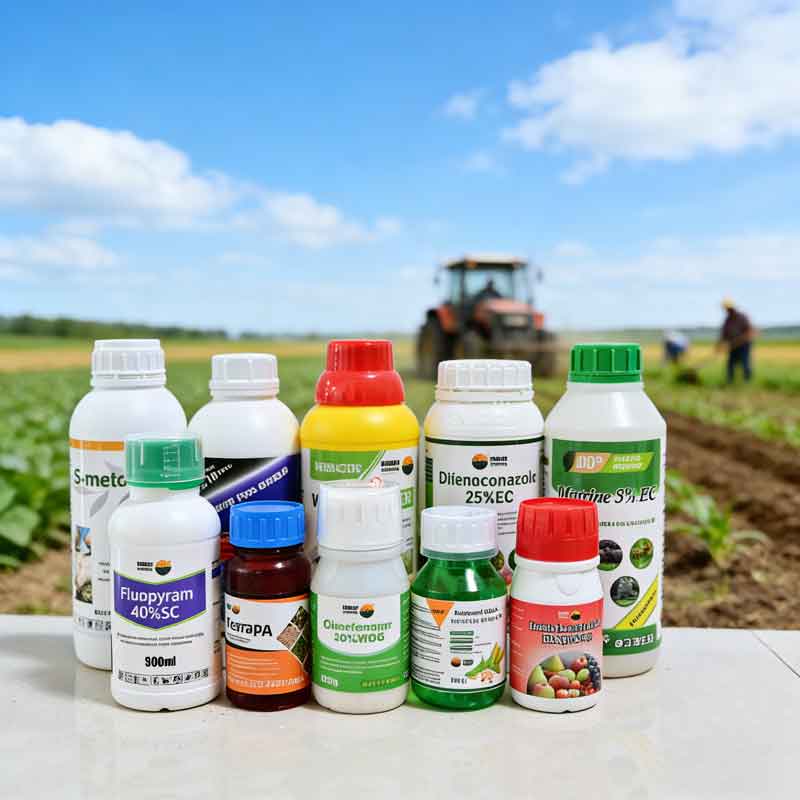
For pesticide importers and distributors, establishing a sucking pest insecticide product line involves more than simply selecting a few active ingredients effective against aphids, whiteflies, or thrips.
The real challenge lies in determining whether it is necessary to introduce products containing Flonicamid, Spirotetramat, or other active ingredients with different modes of action when the product catalog already includes common insecticides such as Thiamethoxam, Acetamiprid, and Dinotefuran.
If several products target highly similar pests, crop ranges, and application scenarios, continuing to add SKUs may only increase registration costs, inventory pressure, and the complexity of sales management.
Conversely, excessive product cuts may prevent distributors from meeting the needs of different crops, pest types, and customer segments.
Therefore, sound product line planning should be based on pest types, life stages, active ingredients, modes of action, and market demand—rather than simply comparing the number of products.
This article will explore, from both technical and commercial perspectives, how to build an insecticide portfolio that covers various sucking pests, identify redundant SKUs, and select products with clear positioning for different agricultural markets.
What Are Sucking Pests and Why Do They Require Different Insecticide Strategies?
Sucking pests represent a significant category in the agricultural insecticide market, but there are distinct differences in their feeding habits, life cycles, and damage patterns.
From a distributor’s product planning perspective, they can be categorized into several major market segments.
1. Aphids
Common species include:
- Cotton Aphid
- Green Peach Aphid
- Cabbage Aphid
- Grain Aphid
Aphids primarily extract plant sap using their piercing-sucking mouthparts and often congregate near young leaves, stems, and growing points.
Severe infestations can cause leaf curling, stunted plant growth, and honeydew accumulation; some species also transmit plant viruses.
When planning product development, the following should be considered:
- Efficacy against adults and nymphs;
- Systemic or other suitable modes of action;
- Suitability for different crops and growth stages;
- Appropriate formulation of products from different IRAC groups.
Flonicamid, thiamethoxam, and acetamiprid can serve as candidates for the aphid product line, but the actual scope of application for each product must be determined based on the specific label.
2. Whiteflies
Common species include:
- Bemisia tabaci
- Trialeurodes vaporariorum
Whiteflies are primarily found on the undersides of leaves; adults and nymphs cause damage by piercing and sucking plant sap.
In addition to direct feeding, whiteflies may transmit plant viruses and affect leaf and fruit quality through honeydew.
The whitefly product line requires special consideration of different life stages:
| Life Stage | English Name | Product Planning Focus |
|---|---|---|
| Egg | Egg | Hatching and Subsequent Population Management |
| Nymph | Nymph | Nymphal development, feeding, and molting processes |
| Adult | Adult | Adult control, feeding suppression, and population control |
Therefore, simply adding more adult control products may not necessarily improve the overall product portfolio.
Products with different modes of action and targeting different life stages—such as Spirotetramat, Pyriproxyfen, and Buprofezin—can be considered, but selection must be based on the target thrips species, life stage, and local registrations.
3. Thrips
Common species include:
- Frankliniella occidentalis
- Thrips tabaci
Thrips differ from typical aphids and whiteflies.
They primarily damage plant cuticles and tissues through a scraping-sucking feeding style and are commonly found on floral parts, young leaves, and growing points.
Therefore, thrips cannot simply be treated using the same product selection logic as all typical piercing-sucking pests.
Distributors should focus on the following:
- the pests’ tendency to hide within floral parts and tender leaves;
- different life stages, such as eggs, larvae, and adults;
- the contact and ingestion modes of action of the pesticides;
- Differences in application between greenhouse and field environments;
- Impact on natural enemies and IPM systems.
IRAC Group 5 products, such as Spinosad and Spinetoram, can serve as potential candidates for the thrips market.
If a distributor’s primary business is greenhouse vegetables and flowers, thrips products should have a distinct market positioning rather than simply serving as ancillary SKUs to whitefly products.
4. Planthoppers and Leafhoppers
These pests are of significant commercial importance in rice, cotton, and other cash crops.
Representative pests include:
- Brown Planthopper
- White-backed Planthopper
- Green Leafhopper
- Cotton Jassid
Different pest species have distinct host ranges, occurrence patterns, and control requirements.
For example, the rice planthopper product line must take into account rice cropping systems and fluctuations in field populations, while the cotton leafhopper product line must be planned in consideration of cotton growth stages and local pest occurrence patterns.
Candidate product directions include pymetrozine, buprofezin, thiamethoxam, and other active ingredients that have been validated as effective in local conditions.
5. Psyllids, Scale Insects, and Mealybugs
These pests are primarily found in the fruit tree and cash crop markets.
| Pests | Key Markets | Product Planning Focus |
|---|---|---|
| Asian Citrus Psyllid | Citrus | Psyllid population management and disease transmission risks |
| Scale Insects | Citrus, Grapes, Fruit Trees | Nymphal mobility and waxy protective coating |
| Mealybugs | Grapes, Mangoes, Citrus | Hidden locations, life stages, and population management |
When selecting products for these pests, one must not only consider whether the active ingredient has insecticidal activity but also take into account the pest’s life cycle, waxy coating, host plants, and application methods.
6. Mites should be addressed separately
It is important to note that mites belong to the class Arachnida and are not insects.
For example:
- Tetranychus urticae
- Panonychus citri
Although they also obtain nutrients by piercing and sucking plant tissues, they should be classified under the Acaricides / Miticides product line.
Therefore, miticides such as Spirodiclofen, Etoxazole, Hexythiazox, Fenpyroximate, and Propargite should not be directly counted as general-purpose insecticides for sucking pests.
Distributors that handle both insecticides and miticides can manage them as adjacent product categories.
Why Do Distributors Need a Structured Sucking-Pest Insecticide Portfolio?
Sucking pests affect multiple crops and various agricultural production scenarios. Without clear product planning, distributors are prone to two opposing problems.
First, products may be overly concentrated, with multiple SKUs effectively covering similar pests and application scenarios.
Second, product coverage may be insufficient; while distributors may carry a large number of insecticides, they may lack products capable of addressing specific pests or offering different modes of action.
Different Crops Require Different Product Combinations
The pressure from sucking pests varies across different crops.
| Crop Market | Primary Target Pests | Product Planning Direction |
|---|---|---|
| Tomato | Whiteflies, Aphids, Thrips | Products targeting multiple life stages and featuring different modes of action |
| Cotton | Aphids, Whiteflies, Jassids | Pest management tailored to growth stages and field conditions |
| Rice | Planthoppers, Leafhoppers | Insecticide combinations specifically for rice |
| Citrus | Psyllids, Scale Insects, Mealybugs | Products for psyllids and other sucking pests of fruit trees |
| Grapes | Mealybugs, Scale Insects | Management of fruit tree pests across different life stages |
| Greenhouse Vegetables | Whiteflies, Aphids, Thrips | Selective Products and IPM Compatibility |
This means that the same product may be a core SKU in one market but merely a supplementary product in another.
More Products Do Not Always Mean Better Market Coverage
For example, a distributor already sells:
- Thiamethoxam 25% SC
- Acetamiprid 20% SP
- Dinotefuran 20% SG
If all three products are primarily used on the same crops and against similar sucking pests in the target market, their commercial value should be assessed before adding more products with the same positioning.
Although they have different active ingredients and product formulations, they all belong to IRAC Group 4A.
This does not mean they have absolutely no value when sold together; rather, it illustrates that one cannot assume they serve different roles in resistance management simply because their active ingredient names are different.
For distributors, the product portfolio should balance pest coverage, mode of action, and commercial differentiation.
Which Insecticide Product Roles Should a Distributor Include?
When building a product line, it is recommended not to categorize products directly by active ingredient name, but rather to first determine the market role each product will fulfill.
Below are several product directions worth considering.
1. Core Systemic Insecticides
Core products typically serve to provide basic market coverage.
For example:
| Active Ingredient | IRAC Group | Product Planning Directions |
|---|---|---|
| Thiamethoxam | 4A | Multiple registered markets for sucking pests |
| Acetamiprid | 4A | Aphids and other applicable sap-sucking pests |
| Dinotefuran | 4A | Markets for specific crops and sap-sucking pests |
These products have a broad international market application base, but the scope of crop and pest registrations varies by country.
Distributors should decide whether to carry multiple Group 4A SKUs simultaneously based on local product registrations, customer needs, and the competitive landscape.
2. Alternative Modes of Action
To reduce reliance on a single mode of action within the product portfolio, active ingredients from other IRAC Groups can be evaluated.
| Active Ingredient | IRAC Group | Primary Product Positioning |
|---|---|---|
| Flonicamid | 29 | Feeding-inhibiting products focused on aphids |
| Spirotetramat | 23 | Systemic management of various sucking pests |
| Pymetrozine | 9B | Feeding inhibition against specific sucking pests |
| Sulfoxaflor | 4C | Products for specific sap-sucking pests |
| Flupyradifurone | 4D | Products for specific sap-sucking pests |
It is important to note that although Sulfoxaflor and Flupyradifurone belong to different subgroups, they are still classified under IRAC Group 4.
Therefore, Groups 4A, 4C, and 4D should not be simply regarded as independent rotation tools with absolutely no risk of cross-resistance. Actual resistance management should be based on the target pest population, local monitoring data, and IRAC recommendations.
3. Insect Growth Regulators (IGRs)
IGR products play a significant role in product lines targeting whiteflies, scale insects, and other specific pests.
Representative active ingredients include:
| Active Ingredient | IRAC Group | Mode of Action |
|---|---|---|
| Pyriproxyfen | 7C | Insect growth and development regulation |
| Buprofezin | 16 | Interference with chitin biosynthesis and molting |
The value of these products lies in offering an alternative to conventional neuroactive insecticides.
However, it is important to note that they may not be suitable for all life stages of every pest.
For example, when positioning buprofezin, special attention should be given to the immature life stages of target pests, while pyriproxyfen should also be evaluated based on the specific pest and its developmental stage.
Distributors can refer to the Product Positioning Analysis of Pyriproxyfen and Buprofezin to gain a better understanding of the differences between these two IGRs.
4. Specialized Pest Control Products
Some products are primarily designed to address specific pest problems and should not be treated as general-purpose insecticides for sucking pests simply to expand the product lineup.For example:
- Spinosad: IRAC Group 5; prioritize thrips and other target pests permitted on the label.
- Spinetoram: IRAC Group 5; establish a distinct product positioning for applicable pests.
- Specific citrus psyllid products: Select based on citrus market demand and actual registration status.
- Products targeting specific scale insects: Focus on the nymphal stage, host plants, and application methods.
If distributors primarily deal in greenhouse vegetables, fruit trees, or cash crops, they can add these specialized products based on customer needs.
How Should Distributors Evaluate Active Ingredients and IRAC Groups?
IRAC Groups serve as a crucial technical basis for planning a portfolio of insecticides targeting sap-sucking pests.
However, distributors should not rely solely on group numbers; they must also understand the mode of action and actual market positioning of each active ingredient.
Compare Active Ingredients by Mode of Action
The following is a reference table to assist buyers in reviewing product catalogs:
| Active Ingredient | IRAC Group | Mode of Action or Product Positioning |
|---|---|---|
| Thiamethoxam | 4A | Nicotinic Acetylcholine Receptor Competitive Modulators |
| Acetamiprid | 4A | Competitive Modulators of Nicotinic Acetylcholine Receptors |
| Dinotefuran | 4A | Competitive Modulators of Nicotinic Acetylcholine Receptors |
| Sulfoxaflor | 4C | Competitive Modulators of Nicotinic Acetylcholine Receptors |
| Flupyradifurone | 4D | Competitive Modulators of Nicotinic Acetylcholine Receptors |
| Pymetrozine | 9B | Modulators of Chordotonal Organ Channels |
| Flonicamid | 29 | Chordotonal Organ TRPV Channel Modulators |
| Pyriproxyfen | 7C | Juvenile Hormone Receptor Modulators |
| Buprofezin | 16 | Inhibitors of Chitin Biosynthesis Affecting CHS1 |
| Spirotetramat | 23 | Inhibitors of Acetyl-CoA Carboxylase |
| Spinosad | 5 | Nicotinic Acetylcholine Receptor Allosteric Modulators |
| Spinetoram | 5 | Nicotinic Acetylcholine Receptor Allosteric Modulators |
These classifications help identify the modes of action of different products, but their actual efficacy against a specific pest cannot be determined based solely on their grouping.
Understanding Group 4A Product Overlap
Thiamethoxam, Acetamiprid, and Dinotefuran are excellent examples of product combinations worth studying.
Although these three active ingredients are different, they all belong to Group 4A.
Therefore, if an importer already carries one of them and is considering adding the other two, they should first ask:
- Does the new product target new crops?
- Does it cover pests that the existing product does not adequately control?
- Does it offer different formulations and application requirements?
- Is there a clear customer demand for these products?
- Can they establish a distinct market position?
If the answers to all these questions are “no,” then adding these new products may simply result in redundant SKUs.
Different IRAC Groups Do Not Automatically Mean Different Commercial Value
Conversely, products in different IRAC groups do not necessarily all need to be procured.
For example, Flonicamid and Spirotetramat have different modes of action, but if there is no corresponding customer demand in the distributor’s market, adding these two products may not necessarily generate commercial value.
Therefore, product portfolio management must consider both technical differences and market differences.
How Can Importers Identify Overlapping Insecticide SKUs?
This is the most critical task in the entire product portfolio management process.
It is recommended that distributors create an SKU Overlap Matrix before introducing new products.
1. Evaluate Five Dimensions Before Adding a New SKU
| Evaluation Dimensions | Key Questions |
|---|---|
| Pest Coverage | Does it cover pests that are not adequately covered by existing products? |
| Pest Life Stage | Does it enhance the ability to manage different life stages of pests? |
| Mode of Action | Does it have a different mode of action? |
| Crop and Application | Does it open up new crop or application opportunities? |
| Commercial Position | Are there new customer needs, pricing strategies, or sales channels? |
If a new product differs only in the name of its active ingredient, while other aspects overlap significantly, a careful evaluation is warranted.
2. Example: Reviewing an Existing Product Line
Suppose a distributor already has the following six products:
| SKU | Active Ingredient | IRAC Group | Primary Product Positioning | Combination Assessment |
|---|---|---|---|---|
| A | Thiamethoxam | 4A | Basic sap-sucking pest product | Core product |
| B | Acetamiprid | 4A | Similar pest market | Evaluate standalone demand |
| C | Dinotefuran | 4A | Similar pest market | Check for product overlap |
| D | Flonicamid | 29 | Focus on aphids | Differentiated complement |
| E | Spirotetramat | 23 | Multiple sap-sucking pests | Stand-alone product role |
| F | Pyriproxyfen | 7C | Management of specific pest life stages | Specialized complement |
As this example shows, there are three Group 4A products in the portfolio, but they do not necessarily all need to be phased out.
If there is a clear commercial need for them across different countries, crops, formulations, and sales channels, they can be retained.
However, if they target the same pests, the same crops, and similar application scenarios within the same market, the procurement volume and product positioning should be reevaluated.
3. When Should a Distributor Keep Multiple Similar Products?
In some cases, it is worthwhile to carry two products simultaneously even if they target similar pests.
For example:
- Different formulations are suitable for different application equipment;
- Different package sizes cater to retail and wholesale channels;
- Different concentrations correspond to different application scenarios;
- One product is primarily intended for cotton, while the other is primarily intended for vegetables;
- Different price points can serve different customer segments;
- Different products have independent registrations and market foundations.
Therefore, SKU overlap does not necessarily mean a product must be discontinued.
What truly needs to be avoided are duplicate products with no clear commercial value.
Importers seeking a deeper understanding of commodity-type and differentiated products may refer to Commodity vs. Differentiated Pesticides.
How Should Sucking-Pest Product Portfolios Differ Across Crop Markets?
Product portfolios ultimately need to be tailored to specific crops and sales markets.
Since pest species, cultivation methods, and procurement needs vary across markets, a single pesticide catalog cannot cover all customers.
1. Vegetable and Greenhouse Markets
The vegetable and greenhouse markets primarily focus on:
- Whiteflies
- Aphids
- Thrips
The product portfolio should take into account the life cycles, locations, life stages, and IPM compatibility of different pests.
For example, the whitefly product line in the greenhouse market can simultaneously evaluate products for adult control, nymph control, and those with different modes of action.
Thrips products, on the other hand, need to prioritize managing hidden life stages within flowers and growing points.
For further guidance on how to build a standalone product portfolio for the whitefly market, refer to Whitefly Control Product Line for Vegetable Distributors.
2. Cotton Markets
For the cotton market, the following should be prioritized for evaluation:
- Cotton Aphid
- Whitefly
- Cotton Jassid
Distributors need to plan for insecticides with different modes of action based on the various growth stages of cotton and pest occurrence patterns.
The product portfolio should not rely solely on Group 4A; distributors should also evaluate whether products with other modes of action can meet local needs.
In addition, the cotton product line should consider synergistic planning with products targeting other pests, such as the cotton bollworm, but should avoid grouping all insecticides under the “sucking pests” category.
3. Rice Markets
The focus for the rice market is:
- Brown Planthopper
- White-backed Planthopper
- Leafhoppers
Rice planthoppers have their own population dynamics and resistance management characteristics.
Distributors should establish a distinct product portfolio tailored to the rice market, rather than directly replicating the sap-sucking pest product catalogs used in the vegetable or cotton markets.
For information on active ingredients, IRAC groups, and product selection for rice planthoppers, please refer to Rice Planthopper Management Products for Distributors.
4. Citrus and Fruit Markets
The citrus, grape, mango, and other fruit tree markets require consideration of:
- Psyllids
- Scale Insects
- Mealybugs
- Aphids
These pests may hide on the undersides of leaves, on branches, on fruit, and in other parts of the plant.
Therefore, the product portfolio should focus on systemic control, management across different life stages, and application coverage.
If a distributor’s primary business is fruit tree pesticides, it is not recommended to stock only traditional broad-spectrum insecticides; instead, a product catalog with clearly defined uses should be established based on major pests and local registrations.
How Can SunAgro Products Fit into a Sucking-Pest Insecticide Portfolio?
The key to building a sound product portfolio is not to include every active ingredient in the catalog, but to ensure each product has a clear market role.SunAgro’s existing insecticide products can serve as a reference for different product positioning.
1. Flonicamid 50% WDG: A Differentiated Aphid Control Product
Flonicamid belongs to IRAC Group 29.
It works by disrupting the feeding behavior of pests, making it a suitable option within an aphid product line as an alternative with a mechanism of action distinct from Group 4A.
Distributors who already carry a variety of conventional neonicotinoid products can evaluate whether Flonicamid can complement their existing portfolio.
Product Planning Focus:
- Aphid Control.
- Mode of action distinct from Group 4A.
- Scope of registration for applicable crops and target pests.
- Market demand for the WDG formulation.
View the Flonicamid 50% WDG product data sheet.
2. Spirotetramat 22.4% SC: Product Focus on Multiple Sap-Sucking Pests
Spirotetramat belongs to IRAC Group 23.
It inhibits acetyl-CoA carboxylase, disrupting lipid biosynthesis, and is effective against a wide range of sap-sucking pests.
Its product positioning can focus on:
- Aphids
- Whiteflies
- Mealybugs
- Scale Insects
- Psyllids
Specific target pests and crop applications must be confirmed based on the actual product label.
Compared to traditional neurotoxic insecticides, Spirotetramat offers distributors distinct product positioning and mechanism-of-action options.
For the fruit tree and vegetable markets, its potential to complement existing product lines targeting sap-sucking pests can be evaluated.
3. Thiamethoxam: Core Products and Formulation Options
SunAgro’s Thiamethoxam product line includes various formulations and concentrations, such as:
- Thiamethoxam 25% SC
- Thiamethoxam 50% DF
- Thiamethoxam 75% WDG
These products all belong to IRAC Group 4A.
Commercial planning for these products can be based on the target market’s formulation requirements, packaging specifications, customer usage habits, and local registration status.
However, it is important to emphasize that different formulations do not alter the active ingredient’s mode of action.
Therefore, the decision to offer multiple specifications simultaneously should be based on procurement costs, market positioning, and sales channels, rather than treating them as distinct resistance management tools.
4. Spirodiclofen: A complementary acaricide, not a general-purpose insecticide SKU
Spirodiclofen belongs to IRAC Group 23 and is primarily positioned for mite control.
Although it belongs to the same IRAC Group as Spirotetramat, their product targets and commercial uses differ.
Therefore, Spirodiclofen should be placed in a separate “Acaricide” product category.
This is also a very important principle in product portfolio planning:
The same mode of action does not imply the same product role, and different product roles do not mean they can be used interchangeably.
What Should Importers Check Before Adding a New Insecticide?
Once a new product has been identified, formal procurement and supplier evaluation must be conducted.
1. Verify Product Specifications and Registration
Before procurement, confirm the following:
- Active Ingredient
- Content
- Formulation
- IRAC Group
- Target Crop
- Target Pest
- Approved Application
- Registration Status
Do not assume that a product has been registered in the target country for specific crops and pest uses based solely on the supplier’s product catalog.
2. Review Technical Documents and Quality
For products that have been on the market for a long time, distributors should also pay attention to:
| Documentation | Primary Uses |
|---|---|
| COA | Batch Quality Testing |
| SDS/MSDS | Product Safety Information |
| TDS | Technical Specifications and Product Information |
| Product Specification | Product Quality Standards |
| Stability Data | Formulation Stability |
| Packaging Specification | Packaging and Shipping Requirements |
In particular, quality consistency across different batches directly impacts the long-term stability of an importer’s operations.
3. Evaluate MOQ, Lead Time, and Inventory
The purchase volume for new products should not be determined solely based on the supplier’s lowest quote.
The following factors should be comprehensively considered:
- Projected sales volume;
- Local growing season;
- Product shelf life;
- Time to complete registration;
- Existing inventory;
- MOQ;
- Production and delivery cycle;
- Sales velocity across different customer channels.
For SKUs with similar modes of action, initial purchase volumes should be planned with particular caution to avoid excess inventory.
4. Evaluate Long-Term Portfolio Value
Distributors should regularly evaluate the actual performance of each product.
If a particular SKU consistently lacks customer demand or overlaps significantly with existing products, distributors should consider adjusting their procurement plans.
Conversely, if a product introduces a new mode of action, meets new market demands for specific crops, or addresses issues that existing products cannot fully cover, it warrants further investment.
Portfolio management is not a one-time procurement decision but an ongoing process of business optimization.
Frequently Asked Questions About Sucking-Pest Insecticide Portfolios
How Many Sucking-Pest Insecticides Should a Distributor Carry?
There is no fixed number that applies to all markets.
Distributors should determine the number of products based on local major pests, crop range, customer demand, product registrations, and existing SKU coverage.
For distributors new to the market, prioritizing the establishment of a core product portfolio with clearly defined uses is typically easier to manage than introducing a large number of similar products all at once.
Which Insecticides Are Commonly Used Against Aphids and Whiteflies?
Candidate active ingredients include thiamethoxam, acetamiprid, dinotefuran, flonicamid, spirotetramat, pyriproxyfen, and buprofezin, among others.
However, these products differ in their modes of action and target life stages and cannot be considered completely interchangeable. Specific selection must take into account pest species, crops, life stages, and local registration labels.
Should Distributors Carry Multiple Group 4A Insecticides?
Yes, but there must be a clear business rationale.
Thiamethoxam, Acetamiprid, and Dinotefuran all belong to IRAC Group 4A.
If they target similar pests and crops in the same market, distributors should carefully evaluate the necessity of duplicate purchases. Multiple Group 4A products should not be used as tools for resistance rotation based on different modes of action.
What Is the Difference Between Systemic Insecticides and Insect Growth Regulators?
Systemic Insecticides primarily emphasize the absorption and translocation characteristics of the active ingredient within the plant, while Insect Growth Regulators (IGRs) primarily function by interfering with insect growth, development, or molting processes.
For example, thiamethoxam is a Group 4A product, while pyriproxyfen and buprofezin belong to Group 7C and Group 16, respectively.
The choice between these two classes of products should be based on the pest species, life stage, and specific application scenario.
Can Different Formulations of the Same Active Ingredient Serve Different Markets?
Yes.
Different formulations may have distinct packaging, compatibility with application equipment, customer usage habits, and commercial positioning.
For example, SC, DF, and WDG may address different product needs.
However, different formulations do not automatically create new modes of action, nor can they be deemed to offer different resistance management options solely based on formulation differences.
How Can Distributors Avoid Overlapping Insecticide SKUs?
It is recommended to establish an SKU Overlap Matrix to compare products across six dimensions: target pests, crop range, life stage, IRAC Group, formulation, and commercial positioning.
If a new product does not offer new market coverage, technical value, or meet customer needs, the necessity of purchasing it should be reevaluated.
Should Acaricides Be Included in a Sucking-Pest Insecticide Portfolio?
They can be planned as a complementary product category but should not be directly classified under general insecticide SKUs.
Mites belong to the Arachnida class and should be categorized under a separate “Acaricide/Miticide” product classification.
This approach facilitates product catalog management and prevents confusion regarding pest categories in technical documentation.
What Should Importers Check Before Purchasing Sucking-Pest Insecticides?
Importers should verify the active ingredient, concentration, formulation, IRAC group, target crops, target pests, local registration status, product quality, COA, TDS, SDS/MSDS, MOQ, and lead time.
In addition, they should assess whether a new product truly complements the existing portfolio, rather than simply adding another similar SKU.
Build a More Efficient Sucking-Pest Insecticide Portfolio with SunAgro
Building a competitive line of sucking-pest insecticides requires considering pest coverage, active ingredients, modes of action, formulation types, product quality, and market demand.
SunAgro provides a wide range of crop protection products to pesticide importers, distributors, brand owners, and registration partners, including insecticides tailored to the needs of various agricultural markets.
Based on your target markets and procurement needs, we can assist in evaluating:
- product selection strategies for different sucking pests;
- product portfolios featuring different active ingredients and IRAC groups;
- various formulations such as SC, WDG, and DF;
- Product specifications and technical documentation;
- COA, SDS/MSDS, TDS, and other documentation;
- Long-term procurement and stable supply plans.
If you are expanding your existing insecticide product line or planning to enter a new market for sap-sucking pests, please contact SunAgro to discuss a product portfolio tailored to your target market.
 Registering Pesticides from China in Egypt: What Importers Should Prepare