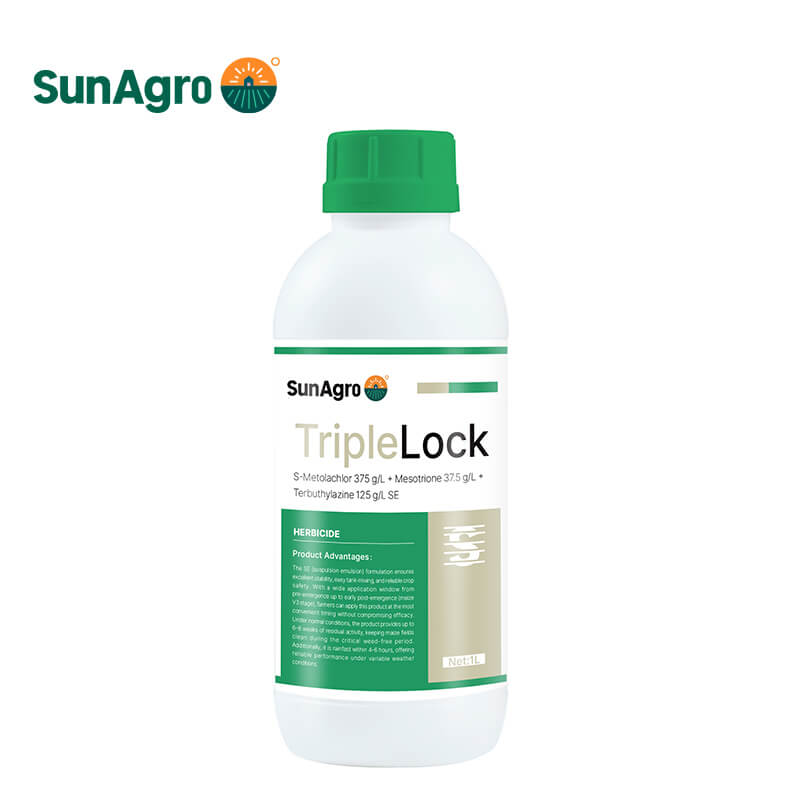
S-Metolachlor 375 g/L + Mesotrione 37.5 g/L + Terbuthylazine 125 g/L SE
S-Metolachlor 375 g/L + Mesotrione 37.5 g/L + Terbuthylazine 125 g/L SE is a selective three-active maize herbicide in suspo-emulsion formulation.
It is mainly positioned for registered pre-emergence and early post-emergence maize weed-management programs, especially where annual grasses and selected broadleaf weeds appear early.
The formula combines Group 15, Group 27, and Group 5 herbicide directions for grass suppression, HPPD-based broadleaf activity, and PSII-based residual support.
SunAgro Science supplies this SunAgro branded maize herbicide for local registration, import, and distribution cooperation.
Stable Formulation Supply
SunAgro Brand Products
Registration Support
Distributor Cooperation
S-Metolachlor 375 g/L + Mesotrione 37.5 g/L + Terbuthylazine 125 g/L SE Description
S-Metolachlor 375 g/L + Mesotrione 37.5 g/L + Terbuthylazine 125 g/L SE Description
| Item | Specification |
|---|---|
| Product Name | S-Metolachlor 375 g/L + Mesotrione 37.5 g/L + Terbuthylazine 125 g/L SE |
| Active Ingredients | S-Metolachlor + Mesotrione + Terbuthylazine |
| Content | 375 g/L + 37.5 g/L + 125 g/L |
| Total Active Content | 537.5 g/L |
| CAS No. | S-Metolachlor: 87392-12-9; Mesotrione: 104206-82-8; Terbuthylazine: 5915-41-3 |
| Formulation Type | SE, Suspo-Emulsion |
| Product Type | Selective Herbicide |
| Main Crop Direction | Maize / Corn |
| Main Use Direction | Pre-emergence and early post-emergence maize weed-management direction |
| Main Target Direction | Selected annual grasses and broadleaf weeds where locally approved |
| HRAC Group | Group 15 + Group 27 + Group 5 |
| Mode of Action | VLCFA synthesis inhibition + HPPD inhibition + PSII inhibition |
| Formulation Position | Three-active SE formulation for maize herbicide channels |
| Resistance Management | Use with herbicide rotation and local resistance-management planning |
| Supply Direction | SunAgro branded product for registration, import, and distribution cooperation |
| Document Support | COA, SDS / MSDS, TDS, product specification, sample support, formulation information, HRAC group information, batch quality information, and available registration-related documents |
| Cooperation Direction | Local registration review, import cooperation, and long-term distribution development |
Main Functions
This formulation is mainly positioned for maize herbicide programs that need grass, broadleaf, and residual support in one structured application direction.
It is not positioned as a universal maize herbicide or a full-season weed-control guarantee.
Main functions include:
- Supports early weed-pressure management in maize
- Helps manage selected annual grass weeds where locally approved
- Supports selected broadleaf weed programs in maize
- Provides residual-support direction through soil-applied components
- Fits pre-emergence and early post-emergence maize programs
- Supports local partners building a three-active maize herbicide portfolio
- Provides a Group 15 + Group 27 + Group 5 program direction for registration review
Final target claims and use directions must follow local registration and approved label requirements.
Mode of Action and Three-Active Value
This product combines three active ingredients with different herbicide group directions.
The combined formula is designed for maize weed-management programs where early annual grass pressure, selected broadleaf weeds, and residual support are all important.
S-Metolachlor: Group 15 Residual Grass Direction
S-Metolachlor belongs to HRAC Group 15.
It is associated with inhibition of very long-chain fatty acid synthesis. In this formula, its role is mainly to support annual grass weed management and soil residual activity where locally approved.
S-Metolachlor is important for maize programs that need early grass weed pressure management during crop establishment.
Mesotrione: Group 27 HPPD Direction
Mesotrione belongs to HRAC Group 27.
It works as an HPPD inhibitor. In maize herbicide programs, Mesotrione is mainly valued for selected broadleaf weed activity and program expansion where local registration supports its use.
Visible weed response may develop gradually and depends on weed species, weed stage, application timing, field condition, and local use practice.
Terbuthylazine: Group 5 PSII Direction
Terbuthylazine belongs to the triazine herbicide direction and is associated with HRAC Group 5 PSII inhibition.
In this formula, Terbuthylazine supports selected broadleaf weed control and residual activity where locally approved.
Its role should be reviewed together with local registration, soil condition, crop safety, and resistance-management needs.
Combined Value in Maize Weed Programs
This product provides three herbicide group directions in one SE formulation.
It can support registered maize weed-management programs where annual grasses, selected broadleaf weeds, and residual-support needs appear together.
Three active ingredients do not mean resistance-proof control. Repeated use of the same program can still increase resistance pressure.
Target Weed Directions
S-Metolachlor 375 g/L + Mesotrione 37.5 g/L + Terbuthylazine 125 g/L SE is positioned for selected maize-field weed directions where approved by local registration.
| Target Direction | Practical Positioning |
|---|---|
| Selected annual grasses | Main grass weed direction where locally approved |
| Early grass infestations | Important during maize establishment |
| Selected broadleaf weeds | Main broadleaf direction according to local label |
| Small broadleaf weeds | Better fit for early post-emergence review |
| Mixed grass and broadleaf pressure | Key program-fit direction for maize fields |
| Early-season weed pressure | Suitable for pre-emergence and early post-emergence planning |
| Residual-support programs | Useful where local registration supports soil residual activity |
This product should not be described as controlling all maize weeds. Actual target spectrum must follow approved local label claims.
Suitable Crops and Application Areas
Maize / Corn
S-Metolachlor 375 g/L + Mesotrione 37.5 g/L + Terbuthylazine 125 g/L SE is mainly positioned for maize / corn weed-management programs.
It can be reviewed where local registration supports the use of this three-active herbicide direction in maize.
Pre-Emergence Maize Programs
This product can be reviewed for pre-emergence maize programs where early annual grasses and selected broadleaf weeds need residual-support planning.
Final suitability depends on soil condition, moisture, rainfall pattern, crop system, and local label directions.
Early Post-Emergence Maize Programs
This product can also be reviewed for early post-emergence maize programs according to local registration.
The final application window depends on maize crop stage, weed stage, local climate, and approved label requirements.
Local Market Application Review
Before registration planning or import cooperation, local partners should review:
- Maize planting system
- Target weed spectrum
- Annual grass pressure
- Broadleaf weed pressure
- Soil condition
- Rainfall and irrigation pattern
- Crop stage and application timing
- Herbicide resistance pressure
- Local registration requirements
- Distributor portfolio position
This helps confirm whether this SE formulation is suitable for the target market and local maize herbicide channel.
Application Guidance
S-Metolachlor 375 g/L + Mesotrione 37.5 g/L + Terbuthylazine 125 g/L SE must be used according to local registration and approved label directions.
General review points include:
- Use only where locally registered
- Confirm maize crop stage before application
- Confirm target weed species and weed stage
- Review pre-emergence and early post-emergence timing
- Review soil condition and moisture status
- Confirm spray volume and dilution practice according to the approved label
- Avoid drift to sensitive crops and non-target areas
- Do not apply to stressed maize unless the approved label allows it
- Avoid repeated use of the same Group 15 + 27 + 5 program without rotation
- Follow local PHI, MRL, safety, and environmental requirements
Final crop scope, target claim, dosage, timing, interval, PHI, MRL, safety requirement, and use restriction must follow local registration and approved label directions.
SE Formulation Features
SE means suspo-emulsion. This formulation type combines suspended solid particles and emulsified liquid components in one water-based system.
For this product, SE formulation helps combine S-Metolachlor, Mesotrione, and Terbuthylazine in a practical liquid formulation for maize herbicide channels.
Key formulation features include:
- Suspo-emulsion formulation
- Suitable for multi-active formulations with different physical properties
- Dispersion stability
- Emulsion stability
- Suspension stability
- Stable dilution behavior
- Particle size control
- Physical stability during storage
- Flowability during handling
- Batch consistency
- Leakage prevention
- Temperature control
For registration review, import cooperation, and distribution planning, SE formulation quality should be evaluated through product specification, sample support, formulation information, and batch quality confirmation.
Product Advantages
Three-Active Maize Herbicide Direction
This formulation combines S-Metolachlor, Mesotrione, and Terbuthylazine in one maize herbicide product.
It supports local markets that need a structured maize weed-management program direction rather than a single-active herbicide option.
Group 15 + Group 27 + Group 5 Structure
The product provides three herbicide group directions:
- S-Metolachlor: Group 15
- Mesotrione: Group 27
- Terbuthylazine: Group 5
This structure can support program review where local registration allows the use of multiple herbicide groups in maize.
Pre and Early Post Program Fit
The product is suitable for markets reviewing pre-emergence and early post-emergence maize herbicide directions.
It should be positioned according to approved local crop stage, weed stage, soil condition, and application timing.
Grass and Broadleaf Program Coverage
This SE formulation supports selected annual grass and selected broadleaf weed directions where locally approved.
It should not be promoted as controlling all maize weeds.
SE Formulation Value
SE formulation supports complex multi-active formulation design and liquid field handling.
It is especially relevant where different active ingredients need to be combined into one stable liquid formulation system.
SunAgro Branded Supply Direction
SunAgro Science supplies this SunAgro branded maize herbicide for long-term cooperation with qualified local importers, distributors, registration companies, agricultural retailers, and crop protection channels.
Difference Between S-Metolachlor + Mesotrione + Terbuthylazine SE and S-Metolachlor + Mesotrione SE
S-Metolachlor + Mesotrione + Terbuthylazine SE and S-Metolachlor + Mesotrione SE are both maize herbicide directions, but their composition and program role are different.
| Item | S-Metolachlor + Mesotrione + Terbuthylazine SE | S-Metolachlor + Mesotrione SE |
|---|---|---|
| Active Ingredients | S-Metolachlor + Mesotrione + Terbuthylazine | S-Metolachlor + Mesotrione |
| HRAC Groups | Group 15 + Group 27 + Group 5 | Group 15 + Group 27 |
| Main Position | Three-active maize herbicide direction | Two-active maize herbicide direction |
| Program Role | Grass, broadleaf, and residual-support direction | Grass residual + HPPD broadleaf direction |
| Terbuthylazine Role | Included as Group 5 triazine direction | Not included |
| Formulation Position | Three-active SE formulation | Two-active SE or other formulation direction depending on product |
The three-active SE product is more suitable where local markets need a Group 15 + Group 27 + Group 5 maize herbicide direction.
The two-active product is more suitable where the target market does not require a Group 5 triazine component or where local registration prefers a simpler formula.
Difference Between S-Metolachlor + Mesotrione + Terbuthylazine SE and Mesotrione 10% OD
This SE product and Mesotrione 10% OD have different product roles.
| Item | S-Metolachlor + Mesotrione + Terbuthylazine SE | Mesotrione 10% OD |
|---|---|---|
| Active Ingredients | S-Metolachlor + Mesotrione + Terbuthylazine | Mesotrione |
| Product Type | Three-active maize herbicide | Single-active HPPD herbicide |
| HRAC Groups | Group 15 + Group 27 + Group 5 | Group 27 |
| Main Position | Pre-emergence and early post-emergence maize program direction | Single-active HPPD broadleaf herbicide direction |
| Formulation | SE, suspo-emulsion | OD, oil dispersion |
| Program Value | Grass, broadleaf, and residual-support structure | HPPD-based direction without Group 15 or Group 5 components |
Mesotrione 10% OD should not be treated as the same market position as this three-active SE formula.
The final product choice should depend on local registration, weed spectrum, application window, resistance-management need, and distributor portfolio planning.
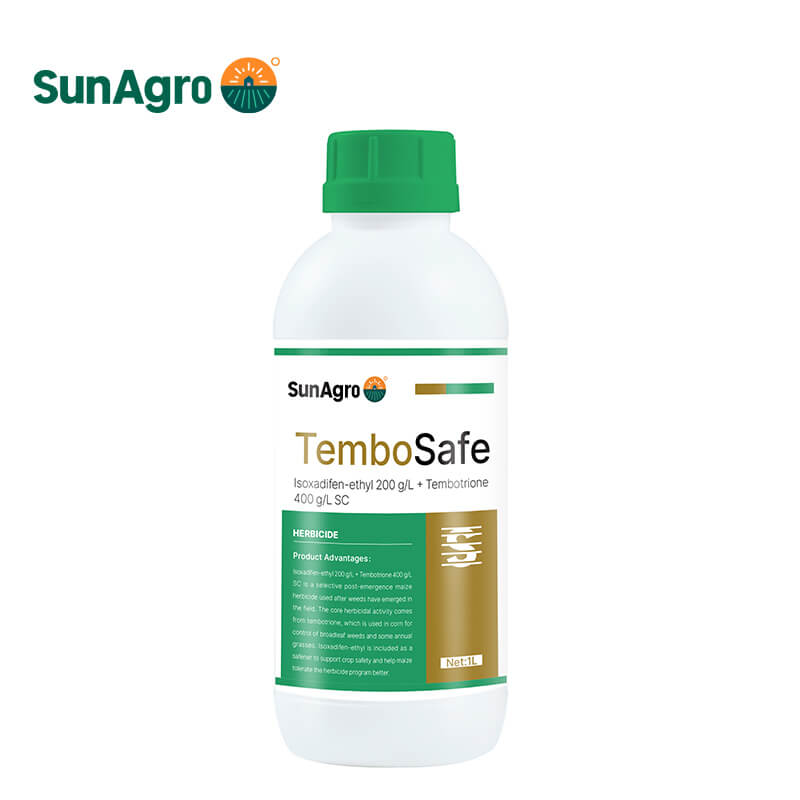
Difference Between S-Metolachlor + Mesotrione + Terbuthylazine SE and Isoxadifen-ethyl + Tembotrione SC
Both products can be connected with maize herbicide programs, but their structure is different.
| Item | S-Metolachlor + Mesotrione + Terbuthylazine SE | Isoxadifen-ethyl + Tembotrione SC |
|---|---|---|
| Main Structure | Three-active herbicide formula | Safener-supported HPPD herbicide formula |
| Active Herbicide Directions | Group 15 + Group 27 + Group 5 | Group 27 herbicide direction |
| Safener Role | No safener positioning | Isoxadifen-ethyl acts as a safener |
| Main Crop Direction | Maize / Corn | Corn / Maize |
| Main Use Direction | Pre-emergence and early post-emergence program direction | Post-emergence corn herbicide direction |
| Formulation | SE, suspo-emulsion | SC, suspension concentrate |
| Portfolio Role | Grass, broadleaf, and residual-support maize program | Safener-supported HPPD post-emergence corn herbicide |
Isoxadifen-ethyl should not be described as a main weed-control active ingredient. In that product direction, Tembotrione provides the Group 27 herbicide activity, while Isoxadifen-ethyl supports crop safety as a safener.
This SE product has a different program role because it combines S-Metolachlor, Mesotrione, and Terbuthylazine in one maize herbicide formulation.
Crop Safety, Resistance Management, and Use Precautions
S-Metolachlor 375 g/L + Mesotrione 37.5 g/L + Terbuthylazine 125 g/L SE must be used with careful crop safety and resistance-management review.
This product contains:
- S-Metolachlor: HRAC Group 15
- Mesotrione: HRAC Group 27
- Terbuthylazine: HRAC Group 5
Three groups can support program diversity, but they do not make the product resistance-proof.
Crop safety may be affected by:
- Maize variety
- Crop stage
- Soil texture
- Soil organic matter
- Soil moisture
- Rainfall after application
- Temperature
- Spray timing
- Tank-mix partner
- Local label restrictions
For resistance management, local programs should consider:
- Rotation with herbicides from different HRAC groups where approved
- Avoiding repeated use of the same Group 15 + 27 + 5 program year after year
- Reviewing known HPPD, PSII, or chloroacetamide resistance pressure
- Using integrated weed-management practices where applicable
- Monitoring fields after application
- Following local resistance-management guidance
This product should not be promoted as a complete or full-season weed-control solution.
Final crop scope, target claim, dosage, timing, interval, PHI, MRL, safety requirement, and use restriction must follow local registration and approved label directions.
Storage and Transport
S-Metolachlor 375 g/L + Mesotrione 37.5 g/L + Terbuthylazine 125 g/L SE should be stored in a cool, dry, and well-ventilated place.
Storage and transport points include:
- Keep containers tightly closed
- Avoid direct sunlight
- Avoid freezing or excessive heat
- Prevent leakage during storage and transport
- Keep away from food, feed, and drinking water
- Store away from children and unauthorized users
- Follow local chemical storage and transport regulations
Before distribution, product condition, batch information, flowability, and container integrity should be checked according to quality and supply requirements.
Registration, Document, and Supply Support from SunAgro
SunAgro Science provides S-Metolachlor 375 g/L + Mesotrione 37.5 g/L + Terbuthylazine 125 g/L SE with available documents and supply support for local registration, import, and distribution cooperation.
Available support may include:
- COA
- SDS / MSDS
- TDS
- Product specification
- Sample support
- Formulation information
- Batch quality confirmation
- Safety information
- HRAC Group 15 + 27 + 5 information
- Resistance-management information
- Maize weed-management program information
- Label information
- Packing information
- Export document coordination
- Available registration-related technical files
This support helps local partners evaluate product feasibility before registration planning, import cooperation, and distribution development.
Stable Supply Behind SunAgro Branded Products
SunAgro branded products are supported by strong formulation production and quality control capability.
Our production system covers liquid formulations including SC, SL, FS, EC, EW, CS, OF, and ULV, and solid formulations including WDG, WSG, WP, TB, DP, and GR.
Annual production capacity reaches 15,000 kiloliters for liquid formulations and 20,000 tons for solid formulations, supporting long-term supply for registered SunAgro products and local distribution cooperation.
FAQ
Request S-Metolachlor + Mesotrione + Terbuthylazine SE Product
Looking for a SunAgro branded three-active maize herbicide in SE formulation for local registration, import, and distribution?
SunAgro Science supplies S-Metolachlor 375 g/L + Mesotrione 37.5 g/L + Terbuthylazine 125 g/L SE for partners who need a Group 15 + Group 27 + Group 5 maize herbicide direction for registered pre-emergence and early post-emergence weed-management programs.
Share your target country, maize market, target weed spectrum, registration plan, formulation preference, resistance-management requirement, and cooperation direction. Our team will help you review product specifications, sample availability, available documents, registration feasibility, formulation suitability, HRAC group information, and supply planning.
Contact SunAgro Science to discuss S-Metolachlor + Mesotrione + Terbuthylazine SE product cooperation.